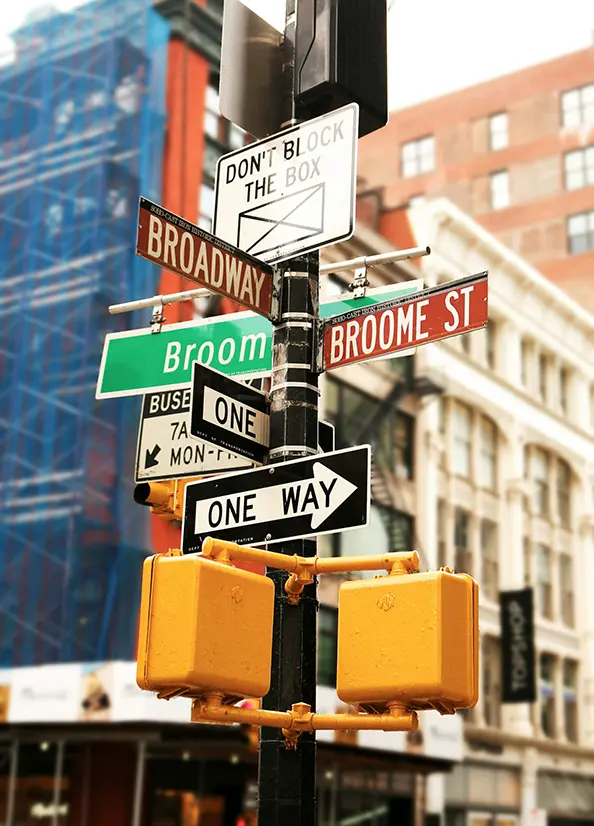
In 1970, Ernest Dwight founded a small signage business, which developed and grew over the years into a vast company, Southwood Corp, Engaged in developing, designing, and producing wayfinding systems, or as he initially called it, architectural signage.
After many years of overall experience in the field, in 2008, he published an article in the American School and University Magazine in which he listed four main types of signs:
Identification sign
The primary signs of this type are signs with an arrow showing which direction I should proceed to reach a particular destination. They can be far from the destination or nearby. Their direct effect is on the movement of the user in the space.
Directional sign
Pellentesque odio nisi, euismod in, pharetra a, ultricies in, diam. Sed arcu. Cras consequat. Praesent dapibus, neque id cursus faucibus, tortor neque egestas auguae, eu vulputate magna eros eu erat. Aliquam erat volutpat. Nam dui mi, tincidunt quis, accumsan porttitor, facilisis luctus, metus.
Informational sign
Provides information that does not directly affect the movement in the space; the information may be relevant to the exact location of the sign, such as a dedication sign or an opening hours sign.
Regulatory sign
The main effect is on the behavior of the travelers in the space, such as a ban on smoking, a requirement for safety equipment, a speed limit, or a height limit.

Additional classifications for signs
Under the four classifications we mentioned above, there are other types of signs that can fall under one of these categories:
Warning signage
- Placing a sign before the risk factor and sometimes in several locations to raise vigilance before direct entry according to authorities' standards.
- For example, the door of an electrical cabinet must be marked as such, or signage on an intercity road warning of dangerous curves.
Honorofic signage
- Signage announcing that the space or building in which it is stationed is dedicated to a person or entity with relation to the building.
- Usually beautiful in institutional buildings such as museums, universities, hospitals, synagogues, and more.
- The content of the sign varies from project to project; there is no basic formula.
Interpretive signage
- It is placed in a unique complex or building for which there is a need or a will to provide explanations and information.
- A content expert is needed to create the sign and validate it.
- Examples of this are signs in the exhibition before exhibits, a sign on a building where an activity of historical value took place, etc.